

Key Takeaways
- The four-beat loop runs in a fixed order: predict, test, observe and record. According to Morgan, the prediction is the step families most often skip.
- Experiments that fail can teach more than ones that work, because the child is left with a real problem to explain.
- A 2014 meta-analysis of 225 studies in the Proceedings of the National Academy of Sciences found students in lecture classes were about 1.5 times as likely to fail as students in active-learning classes.
- The same polymer station can work for a 4-year-old, a 9-year-old and a 14-year-old when the questions at each beat change with age.
- A two-minute notebook entry after each experiment lets separate afternoons build on one another.
Many science activities for children stop at the fizz. A baking soda volcano erupts, the kids cheer, and the tray gets rinsed before anyone asks why the foam rose as high as it did. Dr. Cinttya Morgan, a military and aerospace polymers chemist who founded the children’s lab Little Beakers, argues that the missing piece is usually a routine rather than better equipment.
In Hands-On Science for Kids: The Complete Little Beakers Guide, she describes that routine as a four-beat loop of predict, test, observe and record. The guide also covers the programs families can use at a lab, but any parent or teacher can run the loop with kitchen supplies. The sections below walk through each beat, the research behind the approach and how the routine changes as a child gets older.
Why the Loop Matters: Doing Beats Watching
Morgan’s guide draws on a 2014 meta-analysis in the Proceedings of the National Academy of Sciences that combined results from 225 studies of undergraduate science, engineering and math courses. Students in classes built around active learning scored about 6% higher on exams. Students in traditional lecture sections were about 1.5 times as likely to fail.
Younger children appear to respond the same way. In a controlled study published in 2024, preschoolers who took part in hands-on science activities showed higher science motivation afterward, with gains for both girls and boys as young as 5. A 2009 National Academies report, “Learning Science in Informal Environments,” reached a broader conclusion: a large share of real science learning takes place outside school, in science centers, during family activities and in ordinary daily life.
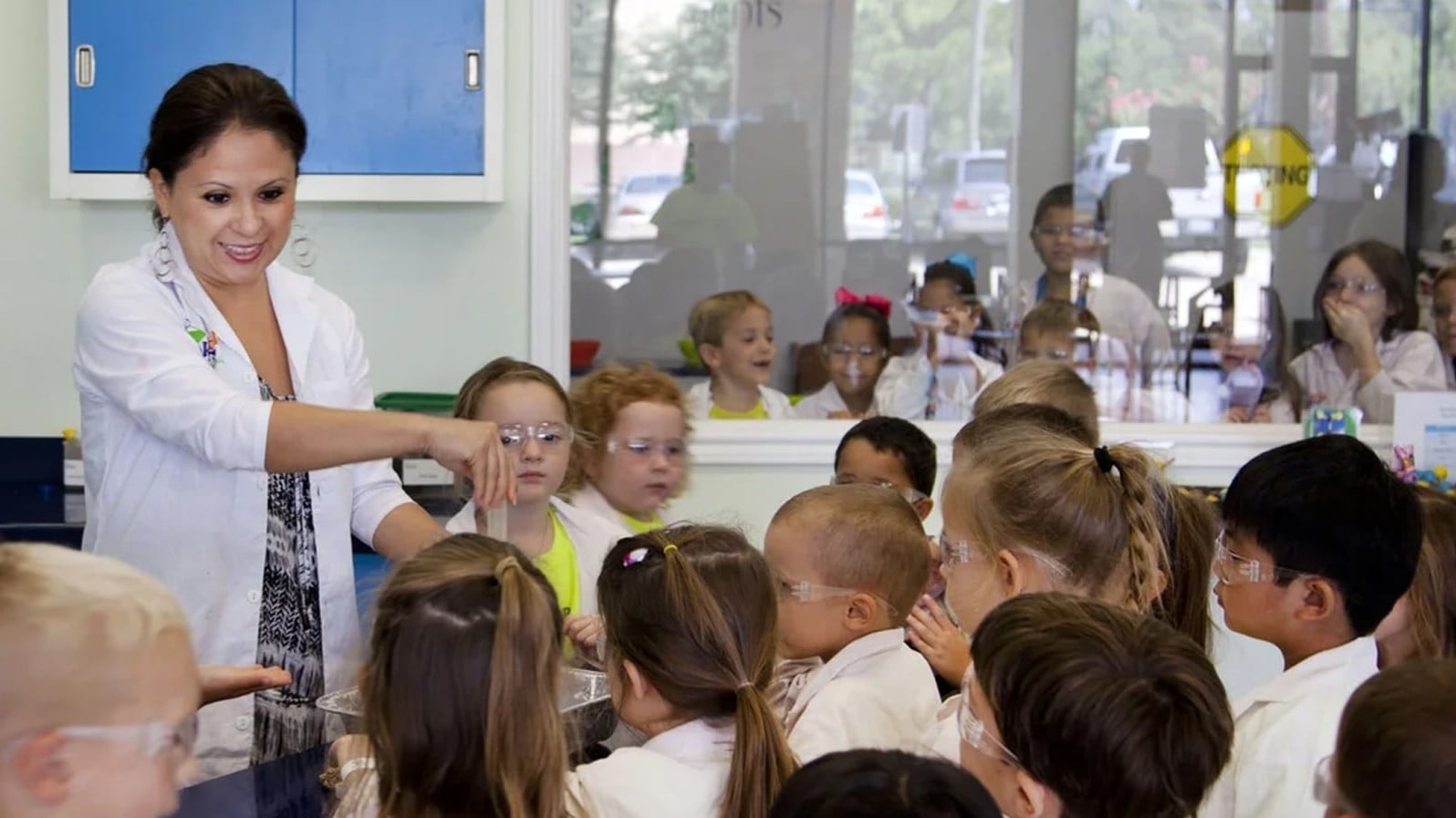
Morgan has watched the same change happen at Little Beakers lab benches, where the company says about 55,000 children have come through its Open Lab program. “The moment a child runs their own reaction, their question changes,” she writes. In her experience, children who begin by asking what something is soon start asking what would happen if they changed it. The loop is designed to get them to that second question more often.
Beat One: Predict
The first beat asks the child to make a guess before anything happens, either out loud or written in a notebook. Morgan writes that this is the step families skip most often, even though it is the one that turns a demonstration into an experiment. “A prediction gives the result something to land against,” she writes.
The guess can be very small. Before mixing baking soda and vinegar, a child might draw a line on the side of the cup to show where the foam will stop. Before flying two paper airplanes, the child can pick which one will go farther and explain the choice. Whether the guess turns out to be right matters much less than having made it, because a result can only confirm or overturn an idea that was stated first.
Beat Two: Test
During the test, the child runs the experiment and the adult resists the urge to fix it. Morgan’s guide is direct that this includes letting experiments fail. Her example is a volcano that barely bubbles because the baking soda in the pantry was old. She argues that it teaches more than a string of perfect eruptions, because the child now has a real problem to work out.
The habit worth building at this stage is changing only one thing between runs. In the kitchen, that could mean using a little more baking soda on the second try, or comparing warm vinegar with cold. With a balloon rocket on a string, a family can race it once, then try a larger balloon or a steeper string on the next run. Paper airplanes work the same way, with a single fold changed before each flight. Keeping every other condition the same is what lets a child connect a cause to an effect, which is the basic design of a controlled experiment.
Beat Three: Observe
Observation in Morgan’s loop goes beyond a yes-or-no verdict on whether an experiment worked. Adults can ask for details, such as how high the foam climbed, how quickly it rose, what color it turned and how it compared with the previous run. The guide treats observation as a skill that improves with practice. Children who are asked for specifics each time tend to start offering them without prompting.
For practice outside the kitchen, the guide suggests a short backyard exercise. The child collects five leaves, sketches each one and then sorts them using a rule of the child’s own invention, whether that is size, the shape of the edges or color. Building a sorting rule from observed features is the basis of classification in biology.
Beat Four: Record
The record takes about two minutes in any notebook. The child writes down what was predicted, what was done and what actually happened.
Morgan describes recording as the step that holds the other three together. Without notes, a month of weekend experiments remains a set of separate memories. With notes, each afternoon can build on the last one. The notebook also gives children a way to look back at their own earlier predictions, and Morgan writes that seeing their own progress this way is one of the strongest motivators in learning.
One Loop, Three Ages: The Polymer Example
Because the loop is simple, it can look like something meant only for preschoolers. The guide uses a single polymer station at Little Beakers to show how the same routine changes as children get older.
With 4-year-olds, the station is mostly sensory. Children mix the polymer, squeeze it and stretch it. The instructor asks observation questions, such as whether it feels more like water or more like dough and what changed after mixing. Making a new substance and describing its properties is the first half of materials science, and young children handle that part well.
Around age 9, the same station becomes a comparison. Children make two batches that differ in one way, for example with more activator added to the second. They predict how the batches will differ, compare them and record the result.
By 14, students work with the chemistry behind the material, including cross-linking, viscosity and how the ratio of ingredients affects texture. At that level, the guide has teenagers design a third batch to reach a specific texture. Working to a target moves the activity from chemistry toward engineering.
The bench and the materials are the same at each age. What changes is how deep each beat goes. The guide notes that this is also why siblings of different ages can work at the same station during a family visit.
A Four-Week Starter Rhythm at Home
Families who want a starting structure can use the four-week plan in Morgan’s guide, which calls for one kitchen-table experiment each week:
- Week 1 focuses on reactions, with three runs of baking soda and vinegar and one amount changed each time. The child writes a prediction before every run.
- Week 2 is a build week. The child races a balloon rocket on a string, adjusts the balloon size or string angle and races it again.
- Week 3 moves outside for observation, with five leaves sketched and sorted by the child’s own rule.
- Week 4 is a lab visit. The family brings the notebook to a reserved Open Lab session at Little Beakers, where the child chooses among more than 30 self-guided experiments.
By the fourth week, the notebook usually shows which kinds of experiments a child keeps returning to. That gives parents useful information about how the child learns.
Where the Home Loop Hits Its Limits
The loop costs nothing at home, but Morgan’s guide is candid that kitchen science eventually runs short in a few areas.
Equipment is the most common limit. Titrations and precise measurement call for tools such as pipettes, burettes and volumetric flasks, which are expensive for a single household but practical when many families share a lab. Morgan notes that a pipette requires a steadiness a plastic spoon never demands, and that children generally handle real tools with more care than adults expect.
Dissection is hard to manage at home, since it requires preserved specimens, proper tools, safe disposal and someone who knows the anatomy. It is also where biology moves from textbook diagrams to structures a child has seen directly.
Working alongside other children matters as well. Comparing results with classmates and defending a prediction are part of how scientists work, and both are difficult to recreate with one child at a kitchen table.
Little Beakers runs the same station standards at five permanent labs: Cypress, The Woodlands and Katy/Memorial in the Houston area, and Sandy and Orem in Utah. Instructors are background-checked and experiments are scaled to each age group. The stations follow the same four beats children practice at home, with more specialized equipment and staff who can explain why a reaction behaved the way it did.
What Progress Looks Like
The guide suggests paying less attention to grades and more to a few changes in behavior. One is the kind of question a child asks, especially a move from “What is that?” toward “What happens if…?” Another is how the child responds to a failed experiment. A child who runs it again rather than quitting is building the persistence that science depends on. Morgan also listens for the first time a child talks about “my experiment,” which she treats as a sign that the child has started to see science as something they do.
None of these signs depends on access to a lab or on a child already doing well in school. According to the guide, they come from repeating the four steps until the routine becomes a habit.
Little Beakers Science Lab for Kids
1-833-543-7522
13040 Louetta Rd
Ste 226
Houston
Texas
77429
United States
