

Key Takeaways
- AI platforms such as ChatGPT, Gemini, Claude and Perplexity are influencing which businesses buyers discover and consider, sometimes before a potential customer visits a company website.
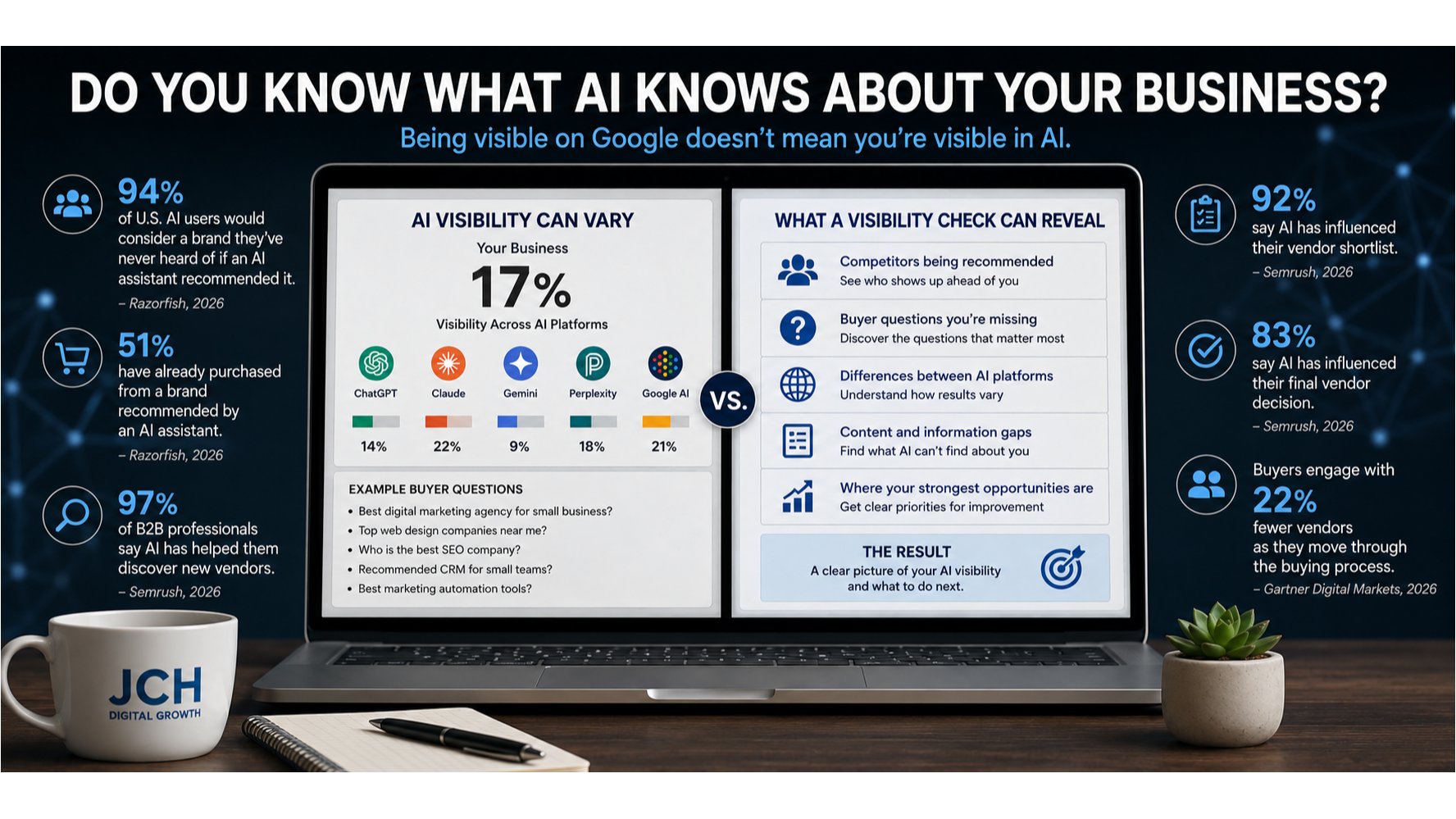
- Razorfish found that 94% of U.S. AI users would consider an unfamiliar brand if an AI assistant recommended it, while 51% had already purchased from an AI-recommended brand.
- Research among B2B buyers also shows AI influencing vendor discovery, shortlists and final purchasing decisions.
- Traditional search visibility doesn’t automatically indicate how prominently a business will appear in AI-generated recommendations.
- AI visibility assessments can reveal which competitors are being recommended, how results differ between platforms and which buyer questions expose significant visibility gaps.
The way buyers find and evaluate businesses has changed significantly, and for many business owners, it happened without any clear warning sign. AI assistants have quietly stepped into the research process, giving people a new way to ask who to hire, which service to use or which company they should consider.
Instead of receiving a page of search results and doing all the research themselves, buyers can now receive a synthesized answer containing a handful of suggested businesses. For companies that aren’t included, the buying journey may continue without them ever knowing they were considered, or that an opportunity existed in the first place.
AI Is Already Influencing Buyer Shortlists
When someone asks ChatGPT, Gemini, Claude or Perplexity who to hire or which company to consider, AI can provide a list of names immediately. That list may include three businesses or five, but what matters just as much is which companies aren’t there.
Some of the clearest evidence of this shift comes from B2B purchasing. Semrush research published in 2026 found that 97% of surveyed U.S. B2B professionals who use AI at work said it had helped them discover new vendors. Another 92% said AI had influenced their vendor shortlist, while 83% said it had influenced their final vendor decision.
Those figures apply specifically to the B2B professionals surveyed, rather than every type of buyer. Still, they illustrate an important change in behaviour: AI isn’t simply helping people find information. It’s increasingly helping determine which businesses deserve a closer look.
For businesses wanting to understand how they appear in these AI-generated responses – and who’s showing up in their place – JCH Digital Growth’s AI Visibility Report offers a direct look at how a business compares to its competitors across major AI platforms.
The Buying Journey Has Quietly Shifted
AI Is Becoming a Starting Point for Purchase Research
G2’s 2026 research involving more than 1,000 B2B software buyers and decision-makers found that 51% now start their software research with an AI chatbot more often than Google. Another 71% use AI chatbots somewhere during the software research process.
Google hasn’t disappeared from the journey. G2 also found that 80% still use it somewhere in the buying process. The difference is that AI has become another front door, allowing buyers to describe what they need, ask for suitable companies and compare options before visiting individual company websites.
AI Can Introduce Buyers to Completely New Brands
This behaviour isn’t limited to business software. Razorfish’s 2026 consumer research found that 94% of U.S. AI users would consider a brand they’d never heard of if an AI assistant recommended it. More than half, 51%, reported that they had already purchased from a brand recommended by an AI assistant.
That creates an interesting shift in competitive advantage. Smaller or lesser-known businesses may be introduced to customers who would never have found them through traditional search, while an established company can be left out of the same conversation. Brand recognition still matters, but it doesn’t guarantee a place in an AI-generated answer.
Buyers Are Engaging With Fewer Vendors
Gartner Digital Markets has also reported that software buyers are engaging with fewer vendors as they move through the purchasing process. The average number of vendor engagements, including activities such as demos and free trials, fell 22%, from 3.2 vendors to 2.5. In the United States, the average dropped to 2.18.
Those figures don’t measure AI recommendations directly, but they add context to the importance of early consideration. If buyers are engaging seriously with fewer companies, being absent while those initial options are being identified may matter more than it once did.
Invisible to AI Can Mean Invisible to Buyers
Strong SEO Doesn’t Guarantee AI Mentions
Many businesses reasonably assume that if they’re easy to find in Google, they’ll also be well represented in AI-generated answers. The two forms of visibility, however, aren’t interchangeable.
AI systems and traditional search engines overlap in some of the information they use, but AI-generated responses can interpret and present that information differently. Results can also vary considerably between AI platforms. A business might appear frequently in ChatGPT responses but rarely in Gemini, Claude or Perplexity.
That makes AI visibility difficult to judge from search rankings or website traffic alone. A company can have an established digital presence and still discover that it appears far less frequently in AI recommendations than expected.
The Silent Lead Loss You Can’t Track
This is what makes an AI visibility gap different from many traditional marketing problems. A poor ad campaign produces declining click-through rates. A weak landing page may show up in bounce or conversion data. When AI recommends a competitor instead, there may be no comparable signal.
A buyer asks which companies to consider, receives several suggestions and moves forward with those names. There is no missed call, abandoned form or analytics event. The business that wasn’t mentioned may never know there was an opportunity to lose.
The real issue is missing consideration, the stage where a buyer begins deciding which businesses are worth investigating. Increasingly, that decision can begin before the buyer reaches a company website.
Why AI May Skip or Misrepresent Certain Businesses
Inconsistent Information Can Create Problems
AI platforms can draw on information from websites, directories, reviews, articles, databases and other online sources, depending on the system and question being asked. When information about a business is outdated, incomplete or inconsistent, those systems have a less coherent picture to work with.
A directory may contain an old service description, a professional profile may use outdated positioning, or an important specialty may be barely mentioned on the company’s website. It isn’t possible to say that one inconsistency caused a specific AI platform to omit a business, since AI systems use different models, retrieval methods and sources. However, reviewing the accuracy and consistency of information is a logical part of investigating visibility problems.
Unclear Messaging Leaves Information Gaps
Businesses also create gaps by failing to clearly publish information customers need. A company may provide a particular service but barely mention it online, serve a specialized type of customer without clearly saying so, or repeatedly answer important customer questions privately while those answers remain absent from its public content.
If that information isn’t clearly communicated, AI has less reliable material connecting the business with those questions. Meanwhile, a competitor with detailed service pages, useful FAQs, articles and credible third-party references may establish a much clearer connection.
The answer isn’t necessarily creating more content. Often, it’s about identifying what hasn’t been explained clearly enough and strengthening the information around the questions potential customers actually ask.
What an AI Visibility Assessment Can Reveal
Competitor Comparison Across Major AI Platforms
An AI visibility assessment examines what happens when major AI platforms are asked questions potential customers might realistically use while researching a purchase. It can reveal how frequently a business appears, which competitors appear instead and whether results differ substantially between platforms.
This matters because AI visibility isn’t one universal ranking. ChatGPT, Claude, Gemini, Perplexity and Google’s AI features can produce different recommendations from similar questions. Looking across platforms provides a broader picture than asking one chatbot a few questions and assuming the results represent overall visibility.
Buyer Questions Can Expose Content Gaps
Another revealing part of an assessment is looking at which questions cause AI to mention a business and which consistently lead to competitors instead. Some topics may produce strong visibility, while closely related questions leave the business out entirely.
Those patterns can identify subjects where the available information about a company may be weak, unclear or difficult for AI systems to associate with the business. Rather than simply producing a visibility score, question-level analysis can point to specific areas where information needs to be clearer or more authoritative.
Even Established Brands Have Blind Spots
A common assumption is that well-known or long-established businesses will naturally be well represented by AI. That isn’t always what the results show.
In one recent AI visibility assessment conducted by JCH Digital Growth, a law firm with more than 70 years in business was tested using questions potential clients might ask while looking for legal services. Eight competitors appeared ahead of the firm.
The example doesn’t mean the firm’s reputation had disappeared, nor does one assessment establish a universal pattern. It demonstrates that longevity and real-world reputation don’t necessarily translate directly into AI visibility. An established business may still have significant blind spots in the answers potential customers receive.
AI Visibility Is Becoming Worth Measuring
AI-generated recommendations aren’t replacing every other way people discover businesses. Search engines, referrals, reviews, advertising and brand reputation continue to influence purchasing decisions. AI has added another layer to that process, and one that can affect consideration before a prospect visits a website or contacts a company.
That makes several questions increasingly relevant. Does AI understand what the business does? Does it connect the company with the questions potential customers are asking? Which competitors appear more frequently, and are there significant differences between AI platforms?
The answers won’t remain static. AI systems change, businesses publish new information and competitors strengthen their own digital presence. An AI visibility assessment is therefore a snapshot rather than a permanent ranking, but it can reveal how a company is being represented at a point in the buying journey that has traditionally been difficult to measure.
As AI becomes a more familiar part of product and service research, one question may matter more than any individual visibility score: when someone asks AI which companies they should consider, is your business part of the answer?
See for yourself – visit Am I The Answer? to learn more.
JCH Digital Growth
Blair St.
Quesnel
British Columbia
V2J5H1
Canada
